
Welcome back to the blog! Last week we discussed magnesium. This week, I thought I’d dive into an electrolyte that a lot of people are interested in: potassium.
What is an electrolyte?
Before I go into all the information about potassium specifically, I thought I’d touch on what exactly an electrolyte is, since I think most people only know that you need them but not what they do in the body.
The simple definition of an electrolyte is a substance that dissolves into water and becomes an ion. The term ion refers to an element, in this case potassium, that has either a positive or negative charge.
As for what an electrolyte does, and why these ions are necessary, I’ll do my best to explain how these positively and negatively charged molecules regulate processes in the body. I don’t want to get too technical here, but in order to understand why we need potassium along with our sodium, I’ll attempt to explain the sodium-potassium pump in the body.
In order to send messages from one cell to another, such as telling muscles to tense, or firing the neurons in your brain, or having your kidneys filter your bloodstream, the cells must first produce an electric charge. That electrical charge comes from moving positive ions in and out of the cell. In chemistry, elements are always looking to maintain electrical equilibrium—aka they don’t want to have an electric charge—so the cells use this built-up electricity to send signals throughout the body.
The membrane of every cell (the protective barrier that keeps all the stuff inside the cell) has a lot of proteins attached to it, including one called ATPase. This ATPase is the door—if you will—of the cell through which sodium and potassium pass through.
The electric charge needed to send signals through the body comes from the sodium-potassium pump found in every single cell. Sodium and potassium are both positively charged. In general, sodium likes to hang out in the bloodstream, while potassium prefers to be inside the cell. The pump works by moving 3 sodium ions from outside the cell in exchange for moving 2 potassium ions from inside the cell. When this happens, the inside of the cell is more negatively charged than outside the cell. This electrical charge is then resolved by completing a process, such as tensing a muscle or sending a message through your nerve cells.
To put it very simply, without sodium and potassium, it’s next to impossible for the body to get anything done.
How much potassium do you need?
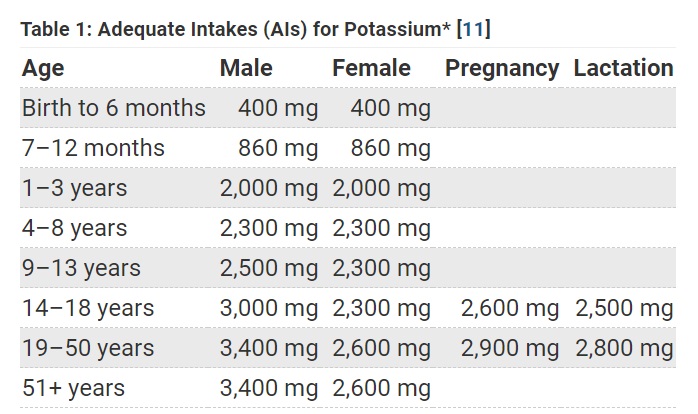
As you can see by the above table, the amount of potassium you need daily really depends on your age and your gender. Just like with magnesium, men generally need more potassium than women. The reason for that is because in general, men have more muscle mass than women. This will of course vary person to person, but because of potassium’s integral role in muscle contraction, men would need a larger amount of potassium to maintain a good balance.
So why is there always a push to eat more potassium but people are told to reduce their sodium intake if both are equally important in the body? The difference between the two is that sodium is readily available in almost everything we eat. Either we salt our food, or we use sodium in the preservatives, so we’re never in short supply of sodium. On the other hand, unless you’re eating a diet filled with more whole, unprocessed foods, you’re not consuming nearly as much potassium. Also, when you’re consuming much more sodium, it can end up causing its own problems. But I’ll save that information for the week I go into sodium on this blog.
Where do you find potassium?
Now that we’ve established that potassium is a vital nutrient, let’s talk more about where you can find it. Because it’s so necessary, there are quite a few foods out there that are rich in potassium, some of which may surprise you.
Sometimes I feel like a broken record because when I get around to talking about where to find certain nutrients, the answer is always seems to be fruits, vegetables, and nuts/seeds/legumes. In the case of potassium, we can also throw in dairy as a good source. But not all foods in those categories have the same amount of potassium so let’s get into which foods specifically give you the most bang for your buck.
| Fruits | Vegetables | Dairy | Nuts/Seeds/Legumes |
| Banana | Potato w/skin | Yogurt | Pinto Beans |
| Papaya | Sweet potato | Milk | Lentils |
| Oranges | Tomato | Ricotta Cheese | Sunflower Seeds |
| Cantaloupe | Mushrooms | Cottage Cheese | Peanuts |
| Honeydew | Brussel Sprouts | Ice Cream | Almonds |
| Pears | Zucchini | Cashews | |
| Peaches | Avocado | ||
| Pineapple | Broccoli | ||
| Strawberries | Corn | ||
| Watermelon | Carrots |
What if I told you that out of all those foods, a potato with the skin on has the most amount of potassium? Believe it or not, you can get a whopping 925mg of potassium from eating a medium baked potato with the skin. Potatoes have gotten such a bad rap over the years that people forget that they are actually a great source of many nutrients. It really all comes down to how you prepare them. Next time you go to make mashed potatoes, try baking the potatoes instead of boiling. Potassium is a water-soluble nutrient, which means you’ll end up with potassium rich water you’re throwing out when you boil them. On the other hand, if you bake them, all that potassium stays in the spud where you can put it to good use when you eat it.
Ice cream is a shocker of a food to list, right? I like that it makes the list of potassium rich foods because it shows that life is not quite so black and white. You don’t want to make ice cream your daily dinner, but also, maybe having the occasional ice cream cone isn’t all bad.
Now that you’re armed with information on potassium and which foods have the most of it, what would it look like to include more potassium rich foods in your diet? As with magnesium, it’s simple. Just pepper in some foods through the day.
For example, add a cup of milk (or soymilk) or some avocado toast to your breakfast, snack on an orange, eat some Mexican food with pinto beans for lunch, make some potato skins for dinner.
Thanks for reading! Let me know in the comments if you have any questions and don’t forget to hit that subscribe button. See you next time!
Need a recipe idea? Try this potassium rich fruit salad
Honey Lime Fruit Salad
(Found on cafedelights.com)
Ingredients
- 1 pound (500 g) strawberries washed, hulled and sliced
- 3 kiwi fruits peeled and sliced into half moons
- 2 mangoes peeled and diced
- 10 ounces (300 g) blueberries washed
- 1 cup green grapes halved
- 9 ounce (250 g) can pineapple chunks or pieces (or ½ of a fresh pineapple, peeled and diced)
- 3 tablespoons honey
- 1 tablespoon fresh squeezed lime juice
- 1 tablespoon pineapple juice (from the canned pineapple, if using)
Directions
- Place prepared washed and sliced or diced fruits in a large salad bowl.
- Using a measuring jug, combine the honey, lime juice and pineapple juice. Pour the syrup through the fruit and mix well. Mix the juices accumulated at the bottom of the bowl once again before serving, if not serving immediately.

 Rachel Case, MFCS, RDN
Leave a comment