
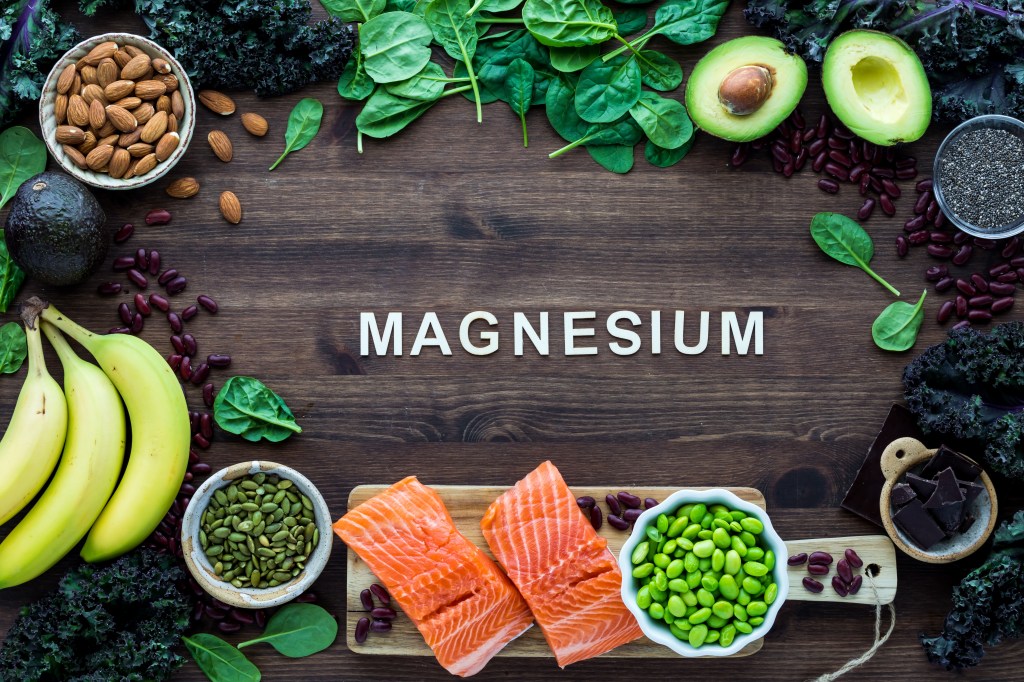
Welcome back to the blog! Last time I talked about what a super food is, and this week I thought I would start a new series where I talk about specific vitamins and minerals, what they do in the body, and where to find them. Also, a disclaimer before we start: Please always make sure to discuss supplements with your doctor before you start taking them, because they can be dangerous to take with certain medications.
Now that that’s out of the way, let’s talk magnesium!
What is Magnesium & what does it do?
Magnesium is one of the body’s major minerals. The definition of a major mineral is one that is needed in relatively large daily doses. Aside from magnesium, sodium, potassium, phosphorus, chloride, sulfur, and calcium are also major minerals.
As for what magnesium does in the body, the answer is: a lot. There are over 300 enzymes in the body that require magnesium for production. Magnesium is integral in the regulation blood pressure and blood sugar, is involved in protein synthesis, and helps with muscle and nerve function. It’s also an important factor in bone production, with 50-60% of the body’s magnesium being stored in our bones.
At the cellular level, it also helps to transport calcium and potassium across cell membranes where they can be used by the body for both muscle contraction and sending signals through our nerves. Magnesium is also involved in the process of DNA production.
Fun fact: Epsom salt is a magnesium-based salt. It’s ability to lower inflammation and pain as a bath soak is directly related to its magnesium content.
How Much Magnesium Do You Need?
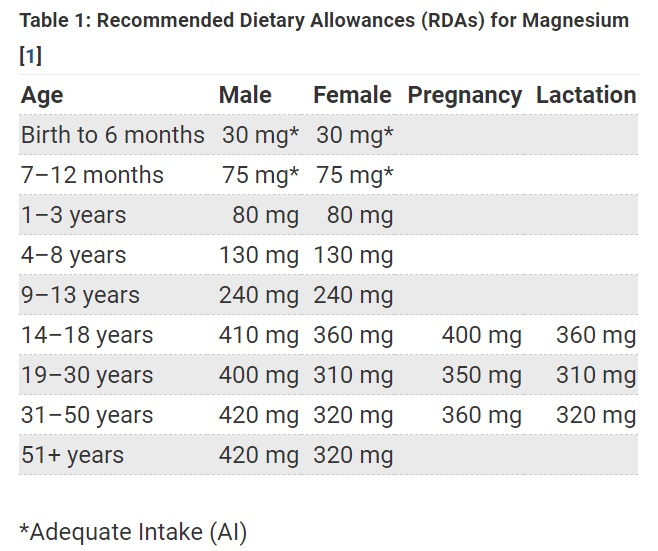
Above is the recommended daily intake for Magnesium here in the US. As you can see, the amount needed differs depending on age and gender.
(For those wondering what an Adequate Intake is, it means that there isn’t enough research to establish a Recommended Dietary Allowance for that age group. It is the amount agreed to be enough to avoid deficiency.)
You’ll also notice that there’s a difference in the amount of magnesium needed between men and women. The reason why men need more magnesium is because magnesium is integral in testosterone production. I’ve already mentioned that magnesium is needed for DNA production, which is why your needs increase during pregnancy, but when it comes to lactation, the reason behind the increased need is simple; breastmilk is how babies are getting nutrients, so mothers are passing magnesium to their infants while nursing.
Where Do You Find Magnesium?
Ok, we’ve established that magnesium is an important mineral and that you need a significant amount of it, but I know the real question here is “where do I find it?”
The simplest place is of course by taking a magnesium supplement, so I’d be remiss if I didn’t touch on supplements.
Some disclaimers on supplements:
- When you’re looking for any supplement, always check that they’re verified by a third party such as Consumer Lab or NSF. This ensures that the supplement is providing what it says it is in the amounts listed on the bottle. A supplement that isn’t third party verified might be fine, but there’s no way to know for sure, and a lot of supplements have been tested and found to have very little (or too much) of the substance they’re supposed to have.
- If you take any medications or have any health conditions, please make sure to consult your doctor or pharmacist prior to starting a supplement, because there are medications that interact with certain supplements and in some cases can lead to hospitalization
In regards to magnesium supplements specifically, try to avoid magnesium oxide. It has a very low absorption rate and often upsets your stomach. Better than that is magnesium citrate. Most people can avoid stomach upset with it and it is better absorbed than the oxide version. And better than magnesium citrate is magnesium glycinate. This is one of the most easily absorbed form of magnesium, so even though it tends to be more expensive, you’re absorbing more of it and getting your money’s worth.
Having said all that, the best way to get any vitamin or mineral is through the foods that you eat. Regardless of the fact that magnesium glycinate is the best absorbed, it’s still less well absorbed than the magnesium you find in foods. Supplements can be useful if you are having a difficult time eating the foods which contain magnesium, or if you have a disease which can inhibit magnesium absorption, but are never a good replacement for eating food itself.
So now that we got all of that out of the way, lets focus on how you can increase the magnesium in your diet. Owing to magnesium’s role in DNA production, you often find it in highest concentration in the seeds of plants. Nuts, seeds, whole grains, and beans/legumes are all excellent sources of magnesium. You can also find it in some greens and soymilk.
So, what would it look like to try to increase the magnesium in your diet? Let’s take an example day, and just add a little magnesium to it. For breakfast, you could have some whole grain toast with a nut butter of your choice. For lunch, try adding in a spinach salad with some seeds sprinkled on top. For dinner, some Mexican food with beans on the side.
Small changes like that might seem like they wouldn’t make a difference, but you’d be surprised how quickly those small servings can add up.
Let me know in the comments if you have any questions and don’t forget to hit that subscribe button to learn more about the nutrients in your diet.
Need a recipe idea to increase the magnesium in your diet? Try this!
Magnesium Energy Ball (recipe found on nondon.net)
Ingredients
- 1 cup pumpkin seeds raw, unsalted
- 1 cup almonds raw, unsalted
- 1/2 cup (about 8) soft dried black mission figs chopped (remove hard stems)
- 4 tbsp maple syrup
- 4 tbsp coconut oil
- 1/2 avocado, ripe
- 1 tsp vanilla bean paste
- 1 cup dark chocolate chips
- 1/2 cup ground almonds
Directions
- Line a baking sheet with parchment paper and set aside.
- Choose a baking sheet or tray that actually fits inside the freezer.
- Place all ingredients, except chocolate chips and ground almonds, in a food processor and process until thick and blended.
- Add chocolate chips and pulse until mixed.
- Divide the processed mixture into 10 portions, and roll each into a ball.
- Place in the freezer for about 1 hour until the mixture firms up.
- Remove balls from the freezer and roll into ground almonds and oatmeal.
- Store in an airtight container in the fridge or freezer for up to one month.

 Rachel Case, MFCS, RDN
Leave a comment