Welcome back to the blog! So far, I have been writing about the reasons why you should go to a dietitian and live diet free, but now I thought we’d switch gears to what most people are truly curious about: what to eat.
Full disclosure, I’m not going to be providing you with a meal plan on this blog, but I do plan to provide some recipe ideas at the end of posts, as well as discussing various foods, fad diets, and help clear the air on what certain buzz words mean.
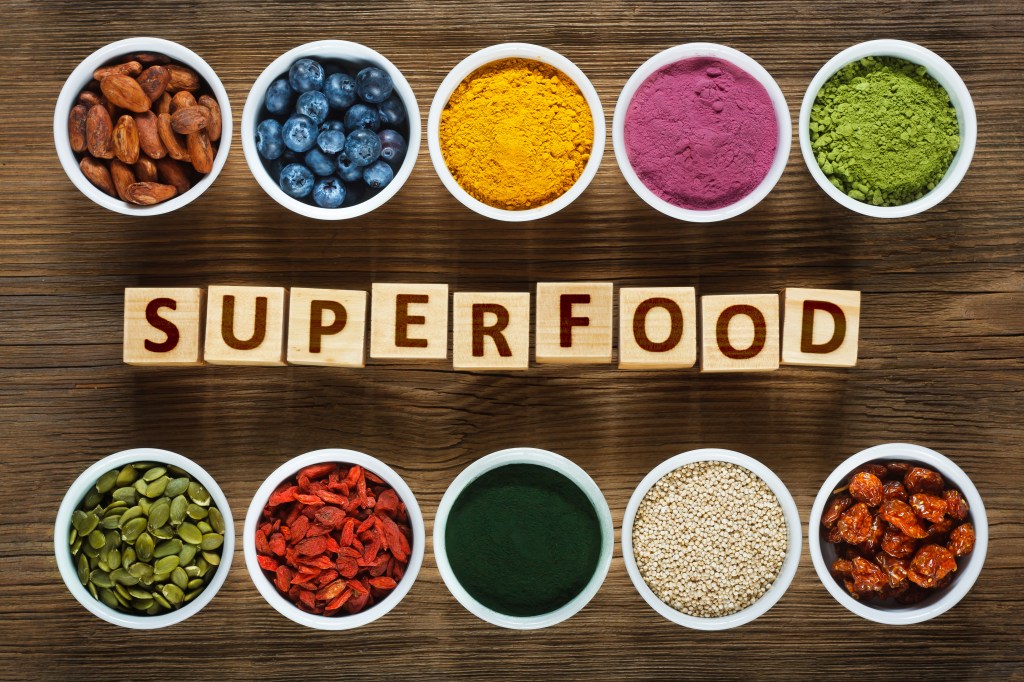
This week’s topic is the buzz word “superfoods.”
Man, that word sounds pretty amazing. A superfood must be the thing you need to eat to be healthy and it must be better than other foods, right? Why else would it be called a superfood?
The truth of the matter is the word was designed to grab your attention. There is no scientific or regulatory definition for what a superfood is. Generally, it is used to describe foods that are high in nutrients while offering minimal calories. Some people will say that it has to have 10 or more nutrients to qualify as a superfood, but again, that’s not regulated and not always followed when promoting a food as a superfood.
The problem with the lack of regulation, aside from the fact that anyone can call anything a superfood, is that most fruits and vegetables offer a multitude of nutrients, so almost any fruit or vegetable can be termed a superfood. Even foods that people think are low in nutrients can have high nutritional impact.
When we’re talking about health benefits, we often list the various vitamins and minerals that are found in the food. However, vitamins and minerals are not the only beneficial nutrients found in the plants we consume. Phytonutrients are also in every single fruit and vegetable and provide a lot of additional health benefits.
“Phytonutrients” is a very broad term to describe the over 25,000 different beneficial compounds found in plants, but I will do my best to simplify it for you. The definition is a chemical compound created by a plant which has been shown to be beneficial to human health. A lot of the antioxidants found in plants, for example, are phytonutrients. Some of the vitamins, such as Vitamin C, are also antioxidants, but are not the only ones present. Also, the specific phytonutrients in plants vary by color. This is a big reason why “eat the rainbow” was a slogan a few years ago.
So, what is the difference between vitamins and minerals and phytonutrients? Vitamins and minerals are compounds that are necessary for function in the human body. You cannot live without them. Phytonutrients are not essential to continue living, but they do provide health benefits. Some of these benefits include an improved immune system, protection for your brain, and decreased inflammation in the body.
Perhaps you have heard that a glass of wine is good for heart health. The reason for that is a phytonutrient called a polyphenol. Interestingly, for those who abstain from alcohol, you can also get similar benefits from drinking grape juice instead. How about eating tomatoes for heart health? Lycopene, a phytonutrient found often in red plants, gives you those benefits. We’ve all heard that drinking green tea is good for you, right? Once again, phytochemicals are the reason for that (and in this case, too numerous to list here without your eyes glazing over.)
Phytonutrients are just one reason why taking supplements is not meant to replace eating healthy. It’s in the name, after all: they’re meant to supplement your diet, not replace it. You can purchase some supplements for phytonutrients like lycopene, but the best way to get all those benefits is from eating a variety of plants in as many different colors as you can swing.
Now that we’ve established what phytonutrients are, let’s talk some specific examples. I plan to go into detail on various types of nutrients and which foods to find them in in future blog posts, but I thought for the purposes of this post, I’d highlight a few foods to show that they have more nutrition than you’d expect.
Up first on the “is it a superfood” list is celery. When asked, most people will say there’s little nutritional value in celery, that it’s more of a supplement to soups or as a low-calorie food source. But did you know that celery contains vitamins K, C, and A, as well as some calcium, potassium, and a variety of other trace minerals? And as for phytonutrients, celery contains carotenoids, polyphenols, phytosteroids, and flavonoids. This means that in studies celery was shown to reduce inflammation, blood pressure, cholesterol, and can lower the risk of cardiac and liver diseases. That’s quite a lot of value for a food most people assume has little nutritional value.
Let’s see how iceberg lettuce stacks up. Most people made the switch from iceberg lettuce to romaine lettuce because they heard that iceberg lettuce is little more than “crunchy water.” If you’ve always thought the same, then you may be surprised to learn that iceberg lettuce also contains vitamins K, C, and A, calcium, folate, and potassium. In the phytonutrient department, you’ll find carotenoids, flavonoids, and polyphenols. Researches have linked intake with lowered risk of Alzheimer’s disease, cancer, and diabetes. It is also just as healthy as other lettuces, so don’t let anyone shame you for choosing to make a salad with iceberg lettuce!
How about potatoes? These tasty vegetables have gotten a really bad reputation in recent decades, with many fad diets proclaiming that they provide no nutritional value and are nothing but empty carbs. Sadly, this is untrue. Did you know a couple centuries before people had ready access to citrus that potatoes were used to prevent scurvy? They are a surprisingly good source of vitamin C! They also contain a good amount of potassium, magnesium, vitamin B6, manganese, phosphorus, niacin, and folate. The phytonutrients they contain vary by species, so it’s good to play around with different varieties in order to get different phytonutrients.
So how did potatoes get such a bad reputation? The problem is simply in how you prepare them. If you boil them, then they do tend to lose nutrients, because those nutrients are what we call water soluble, meaning they will dissolve into water. But if you bake your potatoes, then you retain all those nutrients. Next time you make mashed potatoes, try baking the potatoes and then mashing them, instead of boiling, in order to keep their nutritional value. Also try eating the potato skins. If you don’t like them in your mashed potatoes, then try saving them to make potato skins later.
Ok, so now that we’ve established that celery, iceberg lettuce, and potatoes contain quite a few nutrients, do they actually qualify as a superfood? If the qualification of a superfood is 10 or more nutrients, then with the addition of the phytonutrients, these often misjudged and overlooked foods would actually qualify.
So, what does this mean? As I said before, I want to make sure I’m dispelling the myths and buzzwords so that you can make the most informed decisions on the foods you eat. So, when it comes to calling something a superfood, I think we can hopefully agree that this is just a buzzword to sell you on something. Without a regulation on what a superfood actually is, pretty much every fruit and vegetable is a superfood.
One of the simplest things you can do for your health is eat a variety of different colored plants or plant products. There is no need to buy expensive, exotic fruits and vegetables if the only reason you’re doing so is because you think acai is healthier than blueberries. Instead of trying to micromanage the foods you eat, all you really have to do is introduce variety, in both the type of foods and the colors you eat, and you’ll be giving yourself all those health benefits.
Let me know if there’s any food you’d like me to delve deeper into and I’ll see you again in two weeks! Don’t know what to do with celery outside of soups and some peanut butter? I’ve got you covered. Try these 2 recipes and don’t forget to hit that subscribe button at the bottom of the page!
CELERY AND BLUE CHEESE BUTTER TOASTS
(Found on thepistache.com)
Yields 6-8 toasts
4 or so stalks celery (leaves included), thinly sliced
A couple tablespoons of chopped parsley
2 tablespoons or so good extra virgin olive oil, plus more for drizzling
Juice from ½ lemon
2 small cloves garlic, divided
½ tsp or so salt
Freshly cracked black pepper
2 T butter, room temperature
¼ lb or so mild, creamy blue cheese (see note above)
Loaf of good French bread
Directions
In a medium bowl, combine celery and parsley with the olive oil and lemon juice, and stir until emulsified.
Using a microplane (or mincing very finely if you don’t have one), grate in one garlic clove. Season with salt and pepper to taste.
In a separate small bowl, mix together butter and blue cheese until combined. Cover both and let bowls sit in fridge for a while, up to a day.
When you’re ready to eat, preheat the oven to 400 degrees.
Slice bread into 1-inch thick pieces.
Brush with a bit of oil and toast for 8-10 minutes until golden and crisping up (but still soft in the center, like toast).
Using the other garlic clove, rub each toast with garlic to flavor it.
Spread a generous amount of blue cheese mixture on each toast.
If you want, you can broil for a minute to melt the cheese a little, or you can eat cold as is.
Top each with a heaping pile of celery (and lots of the juice too), and drizzle with more olive oil and more freshly cracked black pepper.
SAUTEED CELERY
(Found on walderwellness.com)
Celery – 1 full bunch
Olive Oil
Fresh Garlic Cloves
Soy Sacue
Rice Vinegar
Optional: Fresh Parsley
Directions
Start by washing celery stalks well and removing any browned or hard ends.
Then, take one stalk and lie it face down on a cutting board. With a chef’s knife, cut down diagonally along the stalk in roughly 1/4-inch pieces. Repeat for all stalks.
Next, mince several cloves of fresh garlic (to your liking) into very fine pieces. Do the same to the parsley if you are using it.
Next, heat olive oil in a large pan. When hot, add the minced garlic and cook for a couple minutes, stirring frequently.
Then, add chopped celery to the pan along with soy sauce/tamari, rice vinegar, and black pepper. Cook for approximately 8 minutes, stirring every 30-or-so seconds.
Finally, turn off the heat and stir in the chopped parsley. Taste and adjust seasonings, as desired and serve hot!

 Rachel Case, MFCS, RDN
Leave a reply to The Case For Magnesium – Rachel Case, MFCS, RDN Cancel reply