Welcome back to the blog! This nutrient series—where I go over different nutrients, where to find them, and how much you need—is now in full swing. I’ve covered the more well-known electrolytes, with my last blog post featuring calcium. I figured, what better time to go over Vitamin D than after calcium?
What is Vitamin D?
As always, I want to start off my discussion with what exactly Vitamin D is. For that matter, what is a vitamin?
A vitamin is an organic compound, most often found in the foods we eat, that is needed in order to perform many functions in the body. The “organic” part of “organic compound” means that it contains carbon as part of the base structure of the molecule.
There are two different sets of vitamins, referred to as water-soluble and fat-soluble. In simplest terms, this refers to how the vitamin is absorbed, moves around the body, and where it is stored. Water soluble means, as you might expect, that the vitamin will dissolve into water. Perhaps you’ve heard that it’s best to roast or steam your vegetables rather than boil them. That’s because the nutrients in vegetables are largely water soluble, so if you boil them, then you’re tossing away the vitamins with the water. Conversely, this is also why broths contain so many nutrients, because the water-soluble vitamins have dissolved into the water base of the broth.
Vitamin D is a fat-soluble vitamin. Fat-soluble vitamins are often found in the oils and fats of plants and animals, and often require fat to be transferred from the GI tract into the bloodstream. Occasionally, a vitamin is found stored within the fat of an animal. For example, cod liver oil which is a naturally occurring food source for Vitamin D.
Have you ever wondered what cholesterol is and why we have it? It actually serves a variety of functions in the body. One of those functions is the production of Vitamin D, one of the few nutrients our body can produce, since it’s not often found in nature and thus difficult to get from your diet.
It is pretty well known by now that the traditional way to get Vitamin D is by going into the sun. The UV rays found in sunlight are part of the process for Vitamin D production. However, we also know that the sun is damaging and being in the sun without sunblock increases the risk of skin cancer. This is why so many people now Vitamin D deficient. UV light is an integral part in producing Vitamin D, so wearing sunblock means that even if you are going into the sun, you’re not producing Vitamin D.
However, do not use this information as an excuse to stop wearing sunblock. There are other ways to meet your vitamin D needs that don’t increase your skin cancer risk. So keep applying that sunblock daily!
What does Vitamin D do?
Now that we know what Vitamin D is, what exactly does it do?
Perhaps the best-known function of Vitamin D is its relationship with calcium. Vitamin D is the main transport for calcium from the GI tract into the blood stream. I won’t bore you with the finer details of that process, but without Vitamin D, the body only absorbs about 10-15% of the calcium you consume. This means that if you’re deficient in Vitamin D, even if you’re getting the recommended amount of calcium daily, you may not be absorbing it, and your risk of osteoporosis later in life is increased.
However, did you know that Vitamin D has many other important functions outside of calcium absorption? It also helps to regulate phosphorus absorption. I haven’t gotten to the importance of phosphorus in the body yet, but one of its functions is bone mineralization. Your bones are not made entirely of calcium, but a matrix of different compounds and minerals. Vitamin D is part of the passive absorption of phosphorus, which accounts for approximately 30% of the phosphorus absorbed from the GI tract.
Speaking of bone mineralization, Vitamin D is also important in this process. Again, I won’t bore you with too many of the finer details (this isn’t school after all), but several nutrients are stored within your bone. Therefore, there is a process in the body, both to form bone and to break it down to access the required nutrients. When you have enough of a nutrient, then the excess is stored, increasing bone density. The formation of bone is completed by cells called osteoblasts, which requires Vitamin D to “turn on”, aka make more bone.
Aside from everything having to do with bone health, Vitamin D also has many other important functions. Vitamin D deficiency has been linked to increased chronic inflammation. The exact mechanisms for that are still being studied, but certain inflammatory markers in the body are elevated in most people with Vitamin D deficiency, whereas those same markers are lower when a person’s Vitamin D status is adequate.
Another function is regulating glucose in the body. Vitamin D deficiency has been linked with insulin resistance, and long-term insulin resistance can lead to diabetes. There aren’t enough studies to verify that Vitamin D deficiency is a risk factor for diabetes, however. More studies are needed to make that claim, but it has been linked to insulin resistance.
How much Vitamin D do you need?
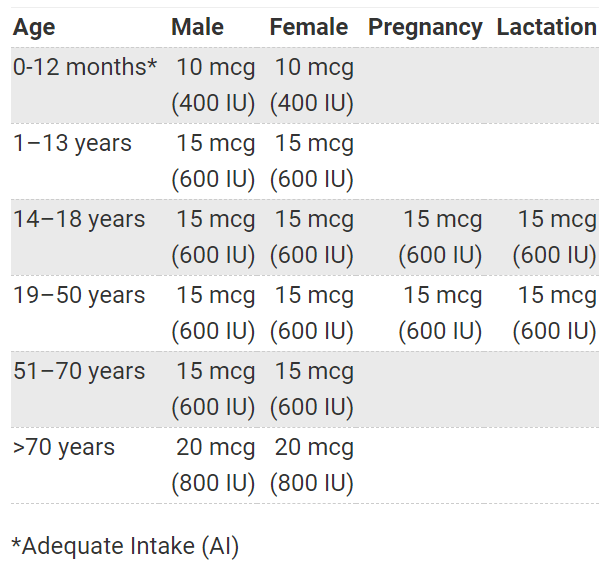
Here is a table listing the recommended amounts of vitamin D based on age and gender. The old standard was to use “international units” aka “IU”, which is what those numbers in parenthesis are. However, as of 2020, the standard unit shifted to micrograms, or mcg. You may still find IU listed on supplements, but more than likely, you’ll see the micrograms listed.
I’ve mentioned in prior blog posts what Adequate Intake is, but just in case, I’ll go over it again. Adequate Intake (AI) is the amount of a nutrient that has been determined as enough to prevent deficiency in most people. Perhaps you’ve seen RDA listed on nutrient labels and have wondered the difference between AI and RDA (Recommended Dietary Allowance)? Whereas AI has been determined as the amount to prevent deficiency, it’s typically used when not enough research has been completed to say with certainty what the recommended amount per day is. RDA, on the other hand, is a value where it’s been determined that this amount will meet the needs of 97-98% of healthy (aka, not deficient) individuals in specific gender and life stages.
When it comes to vitamin D, there actually doesn’t seem to be a difference in requirements between genders and only those under age 1 and over age 70 are recommended to get a different dose outside of 15mcg.
If you are deficient, often your doctor will prescribe a megadose taken over the course of a few weeks in order to bring your levels back up to where they need to be. After that, you can take a normal dose daily.
Where do you find Vitamin D?
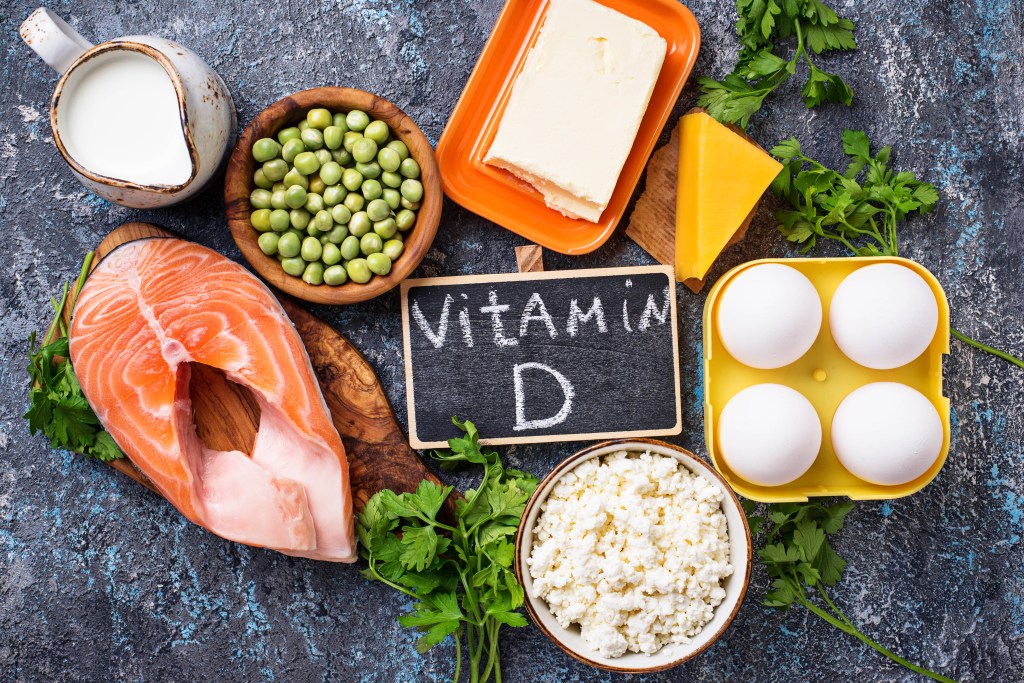
This is where things get interesting, because the answer to where to find Vitamin D is, generally from either sun exposure or by taking a supplement. There are a few food sources, however, including salmon, cod liver oil, tuna, sardines, egg yolk, and fortified foods such as dairy. However, it is still difficult to get the recommended amount of vitamin D solely from food sources, so it is normally recommended to take a daily supplement.
I hope you learned some interesting things today about Vitamin D. This is where I leave you. Don’t forget to hit that subscribe button. Also, feel free to contact me for more information or to schedule a one-on-one consultation. And as always, here’s a recipe to help you boost your vitamin D intake. See you next time!
Pan-Seared Salmon with Creamy Greek Yogurt Lemon Dill Sauce
(Found on zestyolive.com)
Ingredients
- 2 salmon fillets
- Seasoning/Salt and Pepper
- 2 Tablespoons Olive oil
- ¼-1/2 cup water or white wine
For the sauce:
- 1 cup fortified Greek yogurt, plain
- ½ teaspoon salt
- 2 Tablespoon fresh dill, chopped
- 2 Tablespoons fresh lemon juice/OR lemon zest
Directions
- Prep the salmon for pan searing. Rinse and dry the salmon and season it with salt and pepper.
- Add olive oil to stainless steel skillet and heat to medium-high/high.
- Add seasoned salmon, flesh side down to skillet. Sear for a few minutes until a crust has formed.
- Reduce the heat to low/simmer and add a small amount of water or white wine to the skillet and put a lid on it to finish cooking the salmon all the way through.
- Once cooked, remove from pan onto a plate to rest, skin side down.
Making the Greek Yogurt Lemon Dill Sauce
- In a small mixing bowl, add the yogurt, fresh dill, fresh lemon juice (or lemon zest if you prefer), and salt. Stir well to combine. Use immediately or refrigerate up to 3 days.
 Rachel Case, MFCS, RDN
Leave a comment